
NFP Day: What Happens to Forex and Gold
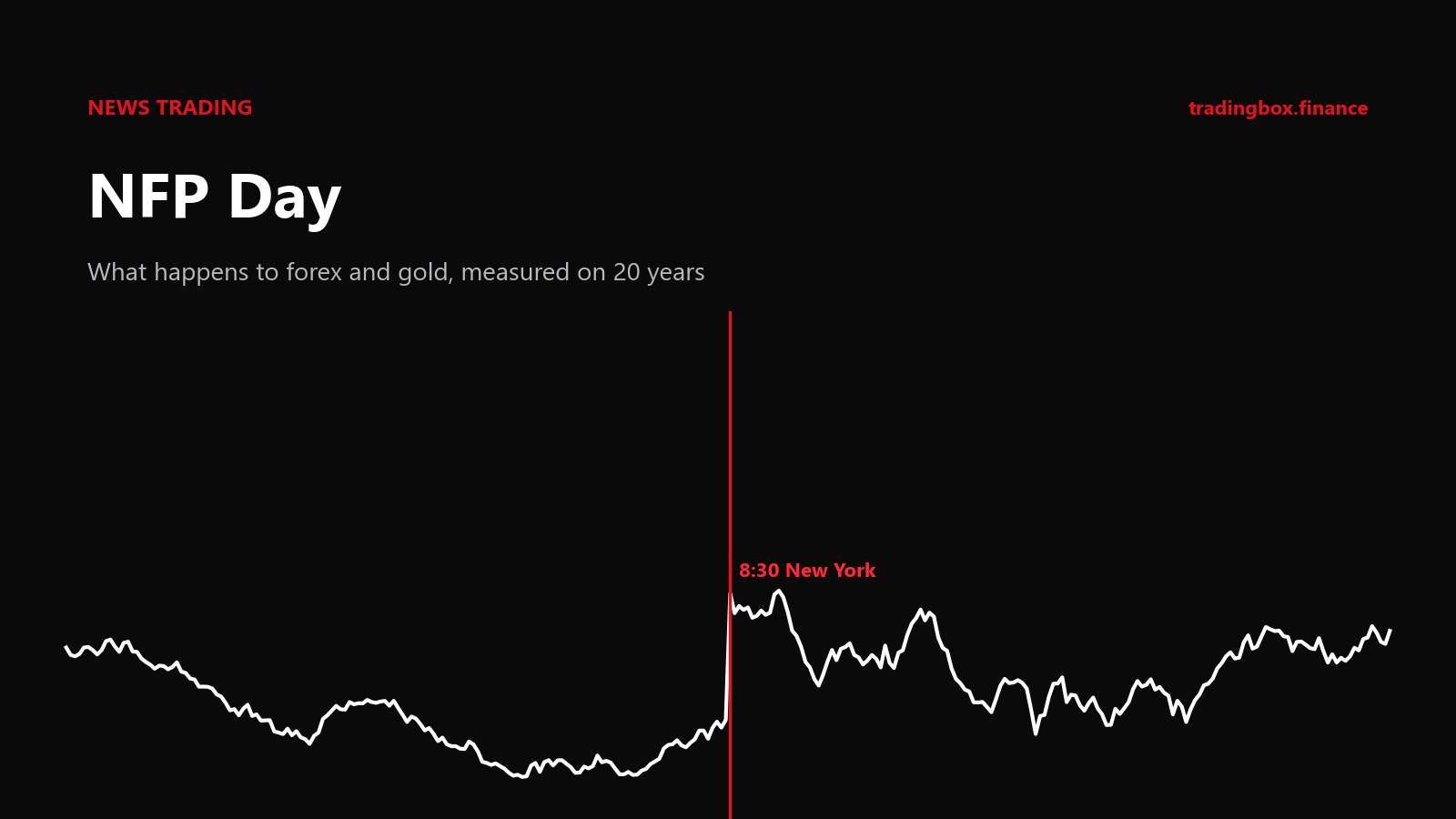
Once a month, at 8:30 in the morning New York time, the US Bureau of Labor Statistics publishes the Employment Situation report, better known to traders as Non-Farm Payrolls (NFP). For many forex and gold traders it is the most important hour of the month.
This guide explains what is in the report, when it really comes out, what usually happens to prices, and how to handle it, with numbers from more than 20 years of releases. It is a companion to How to Use an Economic Calendar.
Key takeaways
- NFP is released at 8:30 New York time: 12:30 UTC in US summer time, 13:30 UTC in US winter time.
- It is usually but not always a Friday: of 261 releases since 2005, 250 were on a Friday, and 36 came after the 7th of the month.
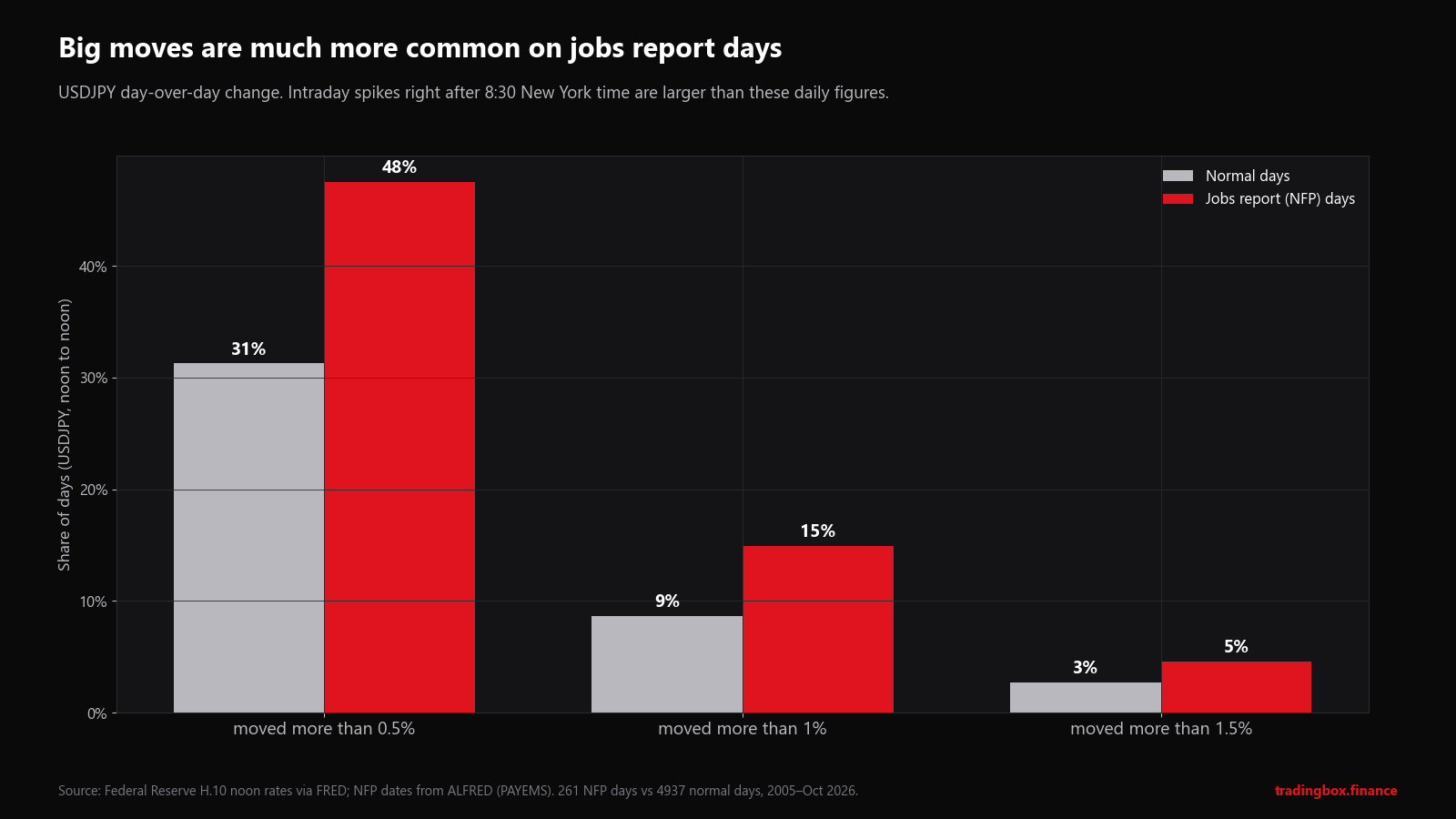
- On NFP days from 2005 to 2026, USDJPY moved more than 1% from the previous day 15% of the time, against 9% on normal days.
- The first minutes are the riskiest: wide spreads, jumps past stops and fast reversals.
- Decide your plan before 8:30: flat, protected, or trade the reaction once spreads are normal.
What is in the report
The Employment Situation combines two surveys:
| Figure | What it measures | Why traders care |
|---|---|---|
| Non-farm payrolls | Change in the number of jobs, excluding farm work | The headline number; strength of the economy |
| Unemployment rate | Share of the labour force without a job | Slack in the labour market |
| Average hourly earnings | Wage growth | Feeds inflation, so it matters for interest rates |
| Revisions | Changes to the previous two months | Can outweigh the headline surprise |
Markets react to the difference between the actual figures and what economists expected, and to what that difference means for the Federal Reserve's next interest-rate decision. A "strong" jobs number with weak wages can produce a very different reaction from a strong number with hot wages.
When does NFP come out?
The usual rule of thumb is "the first Friday of the month". It is right most of the time, but not always. Using the official release dates recorded in the Federal Reserve's ALFRED archive:
- From January 2005 to October 2026 there were 261 releases: 250 on a Friday, 8 on a Thursday, 2 on a Tuesday and 1 on a Wednesday.
- 36 releases came after the 7th of the month, so not on the first Friday.
- In 2026 so far: Friday 9 January, Wednesday 11 February, Friday 6 March, Friday 3 April, Friday 8 May, Friday 5 June, Thursday 2 July (before the 3 July holiday), Friday 7 August, Friday 4 September, Friday 2 October.
- In late 2025, after the US government shutdown, reports came out on Thursday 20 November and Tuesday 16 December.
The next scheduled releases are Friday 6 November and Friday 4 December 2026. Always check the date on the Economic Calendar or the BLS schedule rather than assuming.
Time: 8:30 New York time. In UTC that is 12:30 while the US is on summer time (second Sunday of March to first Sunday of November) and 13:30 in winter. The 6 November 2026 release is after the US clock change, so it is at 13:30 UTC. Your calendar should convert this to your local time automatically; ours does.
How much does it move the market?
We compared every NFP day since 2005 with normal days (excluding NFP and CPI days), using the Federal Reserve's daily noon rates for USDJPY.
| USDJPY move from the previous day | Normal days | NFP days |
|---|---|---|
| More than 0.5% | 31% | 48% |
| More than 1.0% | 9% | 15% |
| More than 1.5% | 3% | 5% |
In plain words: a 1% day in USDJPY is about 1.7 times as likely on an NFP day. Across all NFP days, the average move was about 1.3 times a normal day for USDJPY and 1.65 times for the US 2-year Treasury yield (details in How to Use an Economic Calendar).
Two important limits of these numbers:
- They are day-over-day changes. The move in the first minutes after 8:30 is often larger and partly reverses later in the day. If you hold a tight stop, it is the intraday swing that hits it.
- Most NFP days are not huge. More than half the time USDJPY moved less than 0.5%. The risk is the minority of days when it moves a lot, and you don't know in advance which ones.
What happens to gold
Gold is priced in US dollars and competes with interest-bearing assets, so the jobs report moves it through two channels: the dollar and expected US interest rates. A strong report that pushes up rate expectations tends to weigh on gold; a weak one tends to support it, though not every time. Spreads on XAUUSD often widen sharply around 8:30. If you trade gold through NFP, size for a wider stop; our gold lot size guide shows how.
What happens in the first minutes
- Before 8:30: liquidity thins and spreads widen, sometimes several times their normal size.
- At 8:30: the price can jump instead of moving. Stops become market orders and can be filled past their level (slippage). Pending orders near the price can be filled at a worse price.
- The next few minutes: the first move often reverses as traders read the wages and revisions, not just the headline.
- Later in the day: US markets open, other data or Fed speakers can move prices again.
Your NFP plan
Pick one before the release:
- Stay flat. Close or don't open short-term trades in USD pairs and gold shortly before 8:30, and wait until spreads normalise. The right choice for most traders most of the time.
- Stay in, protected. Keep only positions whose stop is far enough to survive a normal NFP swing, with the size reduced to keep the same risk (see How to Calculate Position Size).
- Trade the reaction. Wait for the first spike and the spread to settle, then trade your normal setup. Trading the exact second of the release is mostly a contest of speed and execution.
If you run an EA, especially one with tight stops, pending orders, a grid or a martingale: pause it or make sure it has a news filter. A good filter reads the release time in UTC, stops new trades a set number of minutes before and after, and refuses to trade while the spread is above a limit. We add exactly this to EAs in our custom EA development work.
Frequently asked questions
What time is NFP in my time zone? 8:30 New York time, which is 12:30 UTC in US summer time and 13:30 UTC in US winter time. Then add your own offset from UTC. Our Economic Calendar converts it automatically.
Why did the market go up on a bad number? Because the market had expected something even worse, or because a weaker labour market makes interest-rate cuts more likely, which some markets welcome. The reaction depends on expectations, not on whether the number is "good".
Is it a good idea to trade NFP? For most retail traders, trading the exact release is unfavourable because of spreads and slippage. Some trade the slower reaction afterwards. Many simply stay out.
Does NFP move pairs without the US dollar? Less directly. Crosses like EURGBP usually react much less, though a big surprise moves most markets through risk sentiment.
Next steps
- Open the free Economic Calendar and read our explanation of the release: Non-Farm Payrolls.
- Size NFP-week trades for wider stops with the free Lot Size Calculator.
Sources
- U.S. Bureau of Labor Statistics: 2026 release schedule (Employment Situation at 8:30 a.m. Eastern; 6 November and 4 December 2026).
- Release dates: ALFRED, vintage dates of the series PAYEMS. Market data: Federal Reserve H.10 noon buying rates via FRED. Calculations: TradingBox, January 2005 to October 2026.
This article is education, not financial advice. Past market reactions do not predict future ones. Trading around news carries a high risk of loss, including slippage beyond your stop.
Trading involves risk. See the risk disclaimer.