
Gold Lot Size in MT5: How to Size XAUUSD Trades
Gold is the most popular non-currency symbol on most MetaTrader 5 accounts, and the one where new traders most often get the size wrong. A lot size that feels small on EURUSD can be a large bet on gold. This guide shows exactly how a gold lot works in MT5, how to calculate the right size for your risk, and why the same lot size is riskier today than it was a few years ago.
This is a companion to our full guide, How to Calculate Position Size. If you just want the number, use the free Lot Size Calculator, which includes XAUUSD.
Key takeaways
- At most brokers one lot of XAUUSD = 100 troy ounces. A $1 move in the gold price = $100 per lot, $10 per 0.10 lot, $1 per 0.01 lot.
- Size gold by price distance in dollars, not by "pips": brokers use the word pip differently for gold.
- With a $5,000 account risking 1% ($50) and a $15 stop, the correct size is 0.03 lots, not the 0.10–0.20 many traders use out of forex habit.
- Gold now moves far more dollars than it used to: the average change from one month's average price to the next was about $232 in 2026, against $65 in 2024 and $12 in 2005.
What one lot of gold is worth
Open Market Watch in MT5, right-click XAUUSD (or GOLD, depending on your broker) and choose Specification. You will usually see:
| Field | Typical value | Meaning |
|---|---|---|
| Contract size | 100 | One lot is 100 ounces |
| Digits | 2 | Price shown as 4,319.25 |
| Tick size | 0.01 | The smallest price step is one cent |
| Tick value | 1.00 (USD account) | One cent on one lot is worth $1 |
| Volume min / step | 0.01 / 0.01 | The smallest trade is 0.01 lots (1 ounce) |
From those numbers:
| Lot size | Ounces | Value of a $1 move | Value of a $10 move |
|---|---|---|---|
| 1.00 | 100 | $100 | $1,000 |
| 0.10 | 10 | $10 | $100 |
| 0.01 | 1 | $1 | $10 |
Not every broker uses 100 ounces. Some offer gold with a contract of 10 or 1 ounce, or quote it with 3 digits. The formula below works for all of them, as long as you take the contract size from the Specification window of the account you actually trade.
Pips, points and dollars on gold
On EURUSD a pip is clearly 0.0001. On gold there is no single agreed pip. Some traders and brokers call $0.10 a pip, some $0.01, some $1. If someone says "I use a 50-pip stop on gold", you cannot know whether they mean $0.50, $5 or $50.
The way out is simple: measure the stop in dollars of price. "My stop is $12 below the entry" means the same thing on every platform.
The formula for gold
Lots = money at risk ÷ (stop distance in $ × contract size)
With a 100-ounce contract:
Lots = money at risk ÷ (stop distance in $ × 100)
Example 1: $5,000 account, 1% risk, $15 stop
- Money at risk: $5,000 × 1% = $50
- Risk per lot: $15 × 100 = $1,500
- Lots: $50 ÷ $1,500 = 0.033, rounded down to 0.03
If the stop is hit, you lose about $45 (0.03 × 100 × $15), slightly under your $50 limit because of rounding down, which is how it should be.
Example 2: $20,000 account, 0.5% risk, $25 stop
- Money at risk: $100
- Risk per lot: $25 × 100 = $2,500
- Lots: $100 ÷ $2,500 = 0.04
Example 3: a small $500 account
- 1% risk = $5
- Even the smallest trade, 0.01 lots, risks $1 per $1 move. A $15 stop on 0.01 lots risks $15, or 3% of the account.
With a very small account, gold leaves little room: either use a tighter stop that still makes sense on the chart, accept a slightly higher percentage on fewer trades, or trade something with a smaller contract while the account grows. The wrong answer is to keep the same stop and trade 0.10 lots.
Why gold blows up forex-sized accounts
On EURUSD, 0.20 lots with a 25-pip stop risks $50. Many traders carry the "0.20 lots feels normal" habit over to gold. On gold, 0.20 lots with a $15 stop risks $300, six times as much. With a $50 stop, which is an ordinary day for gold in 2026, it risks $1,000.
The reason is simple: gold moves many more dollars than a currency pair moves pips, and each dollar on one lot is worth $100.
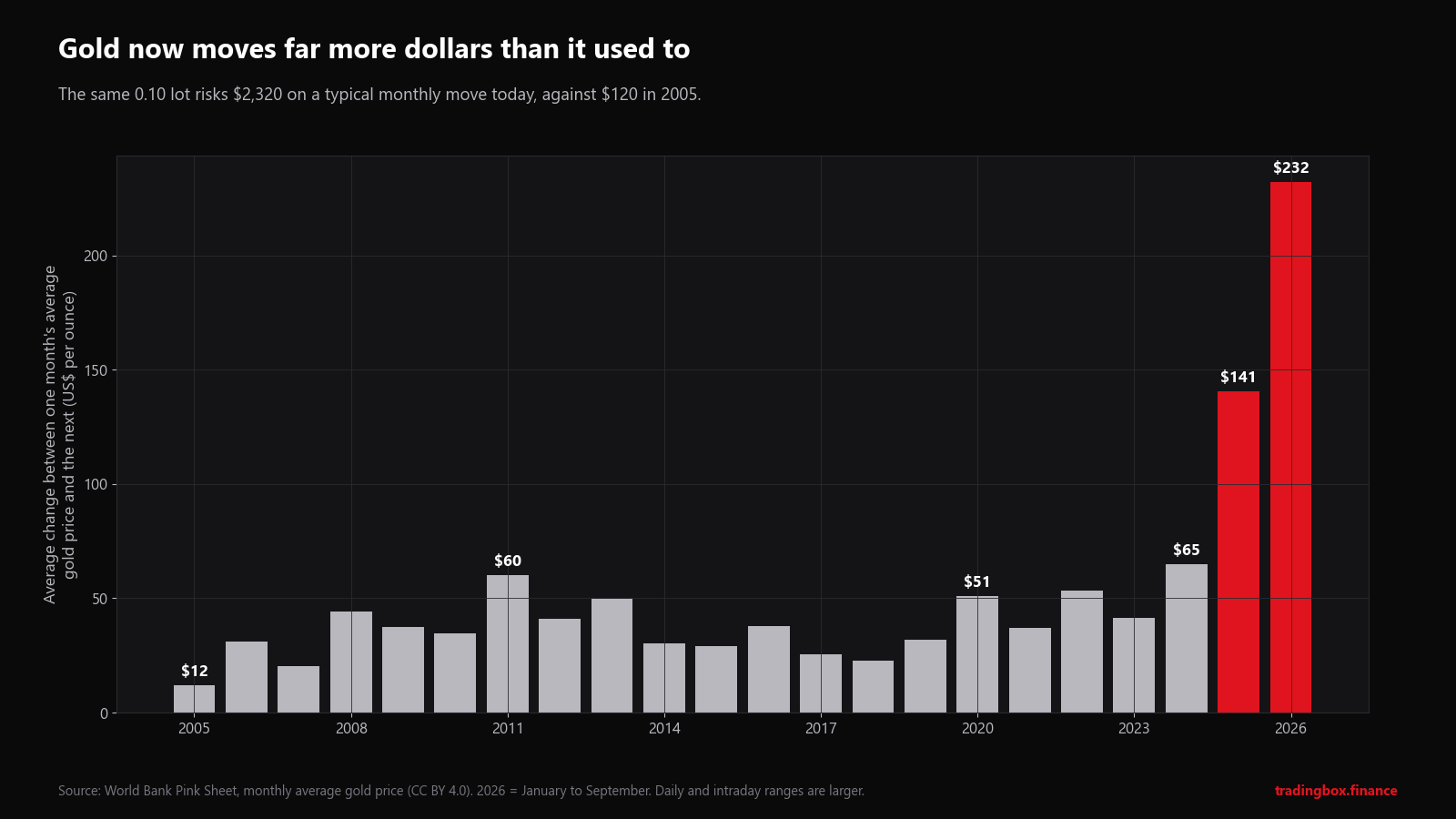
This chart uses the World Bank's monthly average gold price, so it is a calm measure: the real daily and intraday ranges are larger. Even so, the typical change from one month's average to the next went from $12 in 2005 and $65 in 2024 to $232 in 2026, as gold's monthly average price climbed from about $2,650 at the end of 2024 to between roughly $4,100 and $5,000 in 2026.
What it means for sizing: a stop that made sense in dollars a few years ago is now too tight, and a wider stop needs a smaller lot size for the same risk. If your gold lot sizes have not gone down in the last two years while your stops have widened, your risk per trade has gone up.
Margin is not risk
At 20:1 leverage (the limit for retail gold CFDs under the European rules), 0.03 lots of gold at $4,300 needs about 0.03 × 100 × $4,300 ÷ 20 = $645 of margin. At 100:1 it needs about $129. Neither number is your risk. Your risk is still the $45 you lose if the $15 stop is hit. Our position size guide explains the difference in detail.
Gold and US news
Gold is priced in US dollars and reacts strongly to US inflation, jobs data and Federal Reserve decisions. Spreads on XAUUSD often widen sharply around those releases, and a stop can be filled well past its level. Before you hold a gold trade through a release, check the free Economic Calendar, and read how to use an economic calendar. For the longer-term link between gold and the dollar, see Gold vs the US Dollar.
Checklist before every gold trade
- Check the contract size in Specification (100 at most brokers).
- Decide the money at risk (for example 0.5–1% of the balance).
- Place the stop where the trade idea is wrong, and measure it in dollars.
- Lots = risk ÷ (stop × contract size). Round down.
- Check that margin is comfortably below your free margin.
- Check the calendar for US releases during the trade.
Frequently asked questions
How much is 1 lot of gold? At most brokers, 100 troy ounces. At a price of $4,300, that is about $430,000 of gold, and every $1 move is worth $100.
How much is 0.01 lot of gold worth per pip? It depends on what your broker calls a pip. In dollars: 0.01 lot = 1 ounce, so a $1 move is worth $1 and a $0.10 move is worth $0.10.
What lot size should I use for gold with $1,000? At 1% risk ($10) and a $10 stop: $10 ÷ ($10 × 100) = 0.01 lots. With a wider stop, the honest answer may be "no trade" until the account is larger.
Why does my gold lot size differ from someone else's? Different account size, risk percentage, stop distance or broker contract size. Never copy a lot size; copy the method.
Next steps
- Use the free Lot Size Calculator with XAUUSD selected and your broker's contract size.
- Practise sizing gold trades on past charts with the MT5 Candle Replay EA.
Sources
- World Bank, Commodity Markets (Pink Sheet), monthly average gold price (CC BY 4.0). Calculation: TradingBox.
- European Securities and Markets Authority: product intervention measures on CFDs (20:1 for gold).
- MetaQuotes: MetaTrader 5 Help, Market Watch and symbol specification.
This article is education, not financial advice. Trading gold on margin carries a high risk of losing money. Contract sizes and margin rules differ between brokers; check yours before trading.
Trading involves risk. See the risk disclaimer.