
Algorithmic vs Manual Trading: Which Suits You?
"Should I trade manually or use an Expert Advisor?" is one of the most common questions new MT5 traders ask. The honest answer is that it is not a yes-or-no choice. Most consistent traders use some mix of both: their own judgement where judgement helps, and a machine's discipline where discipline helps.
This guide compares the two fairly, shows the levels of automation in between, and gives you a simple way to decide. For how algorithms work in the first place, read Algorithmic Trading for Beginners.
Key takeaways
- Manual trading is better at context: reading news, unusual market conditions and setups that are hard to describe as rules.
- Algorithmic trading is better at consistency: it follows the rules every time, never hesitates, never revenge-trades and can be tested on years of data.
- Each has its own typical failure: manual traders break their own rules; algorithmic traders trust a strategy that was overfitted or never fully tested.
- There are four levels between fully manual and fully automated. Many traders get most of the benefit at level 3: their own entries, with an EA managing size, stops and exits.
Side by side
| Manual trading | Algorithmic trading | |
|---|---|---|
| Decisions made by | You, in real time | Rules written in advance |
| Consistency | Varies with mood, fatigue, recent results | Same decision for the same situation, every time |
| Speed | Seconds | Milliseconds |
| Screen time | High: you must be there | Low once built, but it still needs monitoring |
| Handles the unusual | Good: you can see a war headline or a broken market | Poor: it only knows what it was told |
| Can be tested on history | Slowly, by hand | Quickly, on years of data |
| Typical failure | Breaking your own rules after losses | Overfitted rules, technical errors, nobody watching |
| Skills needed | Market reading, discipline | Precise rules, testing, some programming (or a developer) |
| Cost | Your time | Development time or price, sometimes a VPS |
Neither column is "the professional one". Discretionary traders and systematic traders both exist at every level of the industry.
What manual traders do better
- Read context. A strong jobs report on a day when the market is worried about inflation means something different from the same number when it is worried about recession. A rule rarely captures that.
- Skip bad conditions. Thin holiday markets, a broker with frozen prices, a central bank emergency meeting: a person notices and stays out.
- Adapt quickly. You can change your approach this afternoon. An algorithm has to be re-coded and re-tested.
What algorithms do better
- Follow the plan. The single biggest problem in manual trading is not the strategy but sticking to it: moving stops, skipping trades after losses, doubling size to win it back. An algorithm doesn't.
- Measure the edge. You can test a rule on 10 years of data in minutes in the MT5 Strategy Tester and know its worst drawdown before you risk money. See How to Backtest a Trading Strategy.
- Watch many markets at once, around the clock, and act within milliseconds of a condition being true.
- Size every trade correctly. An EA can calculate the exact lot size from your risk and stop on every trade, on every symbol. See How to Calculate Position Size.
The four levels in between
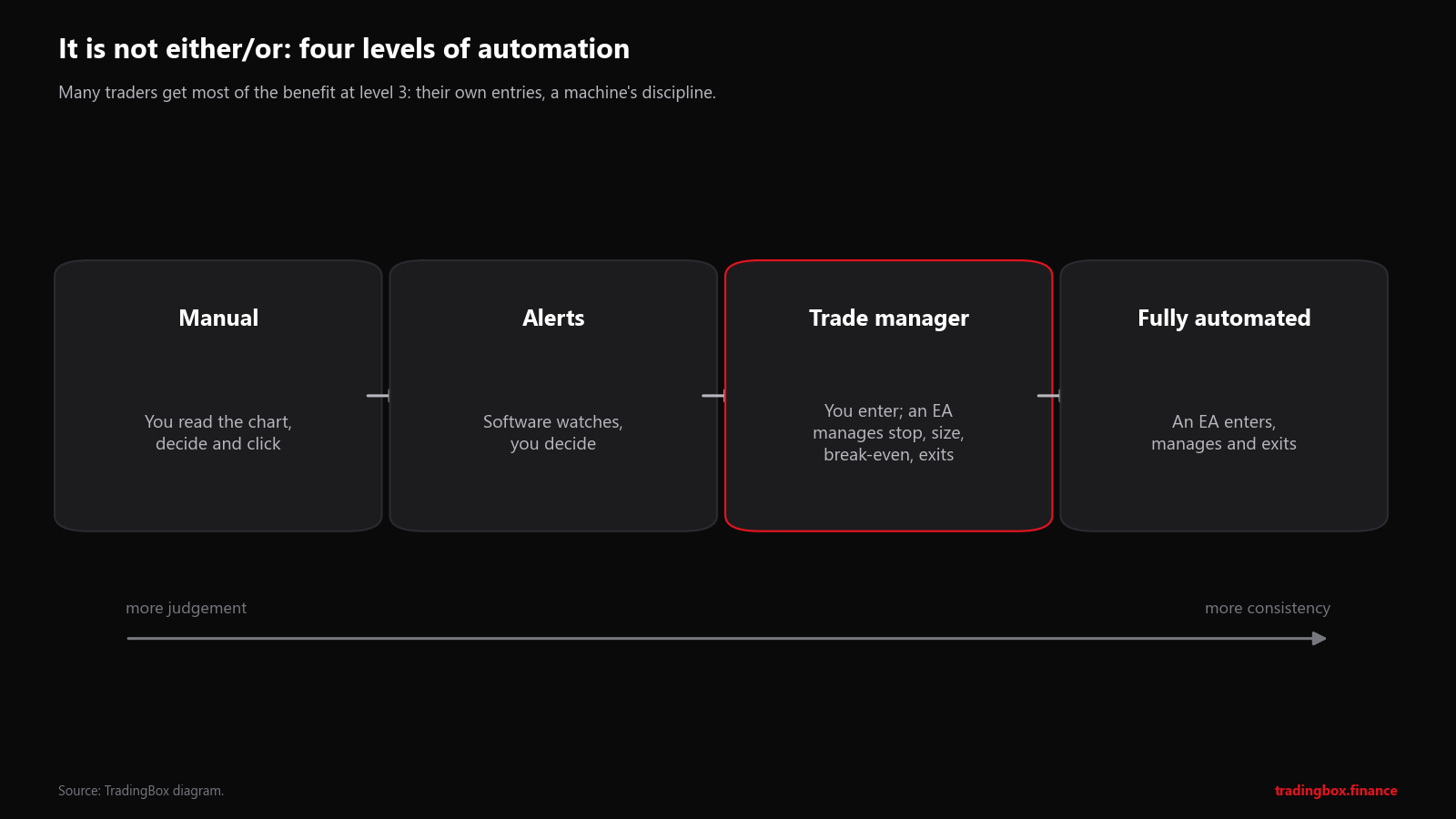
Level 1: Manual. You watch, decide and click.
Level 2: Alerts. Software watches for your conditions (a level, an indicator cross, a news time) and tells you. You still decide. Good for traders who miss setups because they can't watch all day.
Level 3: Trade manager. You choose the entry; an Expert Advisor does the rest: calculates the lot size from your risk, places the stop and target, moves the stop to break-even, trails it, closes at a set time or before news. This removes most of the costly discipline mistakes while keeping your judgement for entries. For many traders this is the best balance.
Level 4: Fully automated. The EA finds, takes, manages and closes trades on its own. You design, test and monitor it.
You can also mix levels by situation: automated for a well-tested trend system on daily charts, manual for discretionary trades around big events.
Common myths
"Algorithms always beat humans." Large firms with huge research budgets do well with algorithms, but an algorithm is only as good as its rules. A simple, popular rule we tested on 26 years of EURUSD data made about +5% in total after costs (see the example in Algorithmic Trading for Beginners).
"Automated means passive income." Every algorithm needs monitoring: connection problems, broker changes, market conditions it was never tested on. The famous failures of automated trading, like the Knight Capital loss of about $440 million in 2012, came from software nobody stopped in time.
"Manual traders can't be systematic." Many discretionary traders follow a written plan with fixed risk per trade and a checklist. That is systematic, just not automated.
"AI will make the choice irrelevant." See AI Trading Bots vs MT5 Expert Advisors: machine learning is a tool inside algorithms, not a replacement for testing and risk control.
How to choose
Answer honestly:
- Can you write your strategy as exact rules? If yes, test it as an algorithm, even if you trade it by hand. If no, you are trading manually, and that is fine, but write down as much as you can.
- What goes wrong in your trading today? If it is discipline (moving stops, revenge trades, wrong size), a level 3 trade manager fixes most of it. If it is the strategy itself, automation will only make the losses more consistent.
- How much time can you watch the screen? Little time favours alerts or automation.
- Do you enjoy building and testing? Algorithmic trading is half research. If that sounds tedious, level 2 or 3 is probably your level.
Frequently asked questions
Is algorithmic trading more profitable than manual trading? Not by itself. Automation makes a strategy consistent; it does not create an edge. A good manual trader with discipline can outperform a poor algorithm and the other way round.
Can I start with manual trading and automate later? Yes, and it is a sensible path. Trade manually with written rules, record every trade, and automate the parts that are clearly rule-based once you trust them.
What is a semi-automated EA? An Expert Advisor that only does part of the job, usually trade management: lot size, stop, target, break-even, trailing and exits, while you choose the entries.
Do I need to code to automate? To build your own, some coding helps (MQL5, Python or Pine Script). Otherwise, you can describe your rules to a developer.
Next steps
- Have rules you already follow by hand? We can turn them into a full EA or a trade manager with your risk limits built in: custom EA development.
- Practise your manual rules on past charts with the MT5 Candle Replay EA before deciding what to automate.
- Read next: What Is an Expert Advisor in MT5?
Sources
- Knight Capital Group, Form 8-K, 6 August 2012.
- EURUSD example: Federal Reserve H.10 data via FRED, TradingBox backtest (details in the linked article).
This article is education, not financial advice. Manual and automated trading both carry a high risk of losing money.
Trading involves risk. See the risk disclaimer.