
AI Trading Bots vs MT5 Expert Advisors
Search for "AI trading bot" and you will find promises of 30% a month, "no losing trades" and robots that "learn the market by themselves". Search for "MT5 Expert Advisor" and you will find something much plainer: programs that follow trading rules inside MetaTrader.
Are they the same thing? Sometimes. Often the "AI bot" is an ordinary Expert Advisor with a new label. Sometimes it is a real machine-learning model. And sometimes there is no bot at all, just a scheme collecting deposits.
This guide explains the real differences, what artificial intelligence can and cannot do in trading, and how to check any robot before you trust it with money. We build Expert Advisors ourselves, so we will be specific, and skeptical.
Key takeaways
- An Expert Advisor (EA) is a program that runs inside MetaTrader and follows exact rules. Most EAs contain no AI at all, and that is not a weakness.
- A machine-learning EA uses a model trained on past data to make a prediction; normal rules still decide the stop, size and exit. MetaTrader 5 can run such models (ONNX format) since 2023.
- "AI bot" is a marketing word, not a technical one. In 2024 the US Commodity Futures Trading Commission warned that AI cannot predict the future or sudden market changes, and that promises of huge or guaranteed returns are a fraud warning sign.
- A robot that "never loses" usually hides its losses in open trades (martingale, grid). In our simulation, 15% of such accounts lost about three quarters of their balance in a single losing run.
- Judge any robot by evidence you can check: its rules, a backtest you can run yourself, a verified live history and its worst drawdown.
Three very different things called a "trading bot"
1. The rule-based Expert Advisor
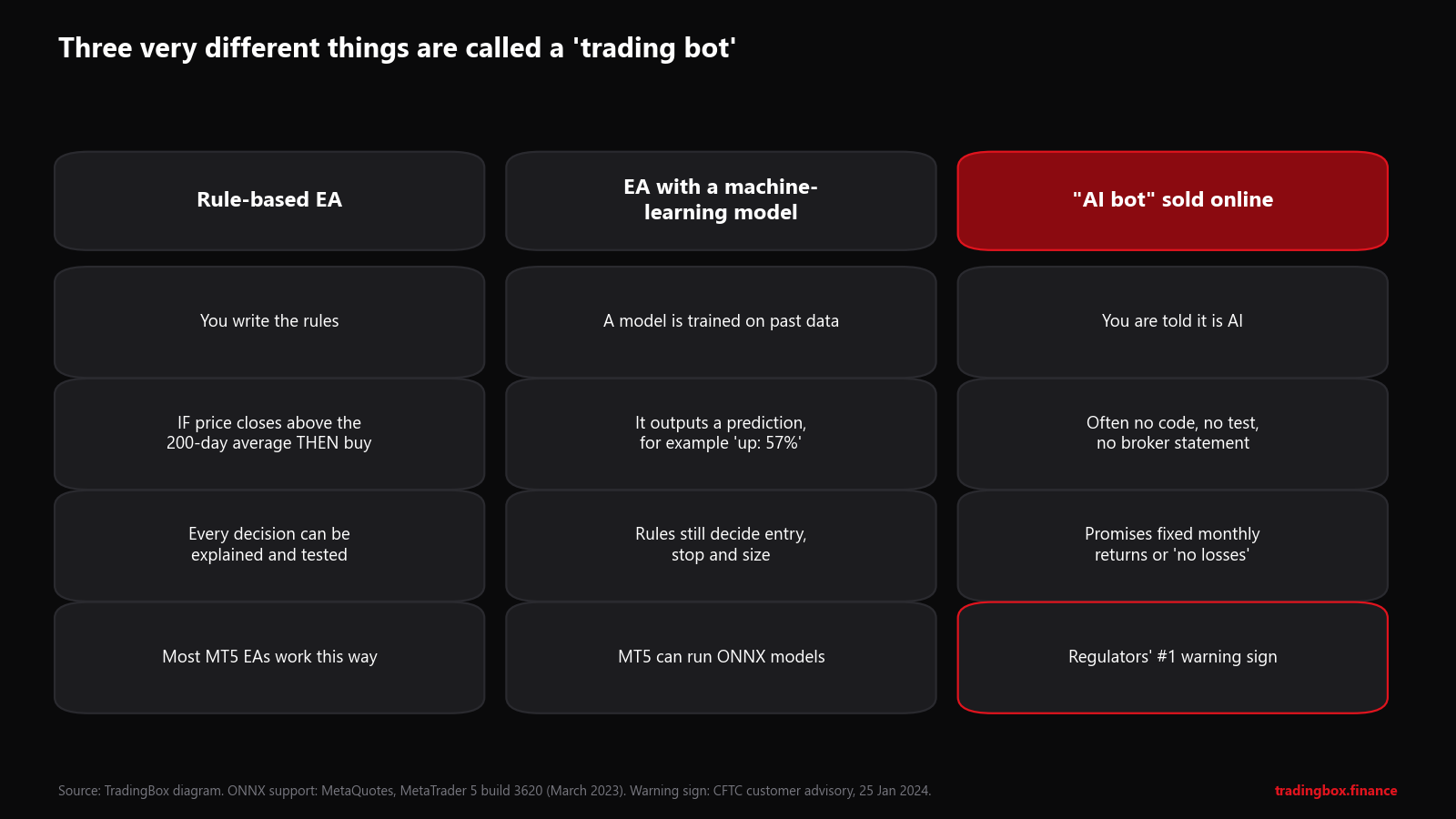
This is what most MT5 Expert Advisors are (new to EAs? Start with what is an Expert Advisor). Someone writes the rules in MQL5, MetaTrader's programming language:
IF the 20-period average crosses above the 50-period average AND the spread is below 2 pips AND no high-impact news is due in the next 30 minutes, THEN buy 0.10 lots with a 30-pip stop and a 60-pip target.
The EA checks the conditions on every price tick and acts the moment they are true. It does not "think", but it never hesitates, never gets tired and never revenge-trades.
Strengths: every decision can be explained, tested in the MT5 Strategy Tester and repeated. If it loses money, you can find out why.
Weaknesses: it does exactly what it was told, including in market conditions its author never imagined.
2. The EA with a machine-learning model
Here, part of the decision comes from a model trained on historical data. For example, a model might look at the last 50 bars, volatility and the time of day and output "probability the next 4 hours close higher: 57%". The EA then uses ordinary rules: trade only above 55%, fixed risk, fixed stop.
Since build 3620 (March 2023), MetaTrader 5 can load models in the open ONNX format, so a model trained in Python can run inside an EA and be tested in the Strategy Tester.
Strengths: can combine many inputs in ways that are hard to write as simple rules.
Weaknesses: easy to overfit (the model memorises the past instead of learning something that lasts), harder to explain, and markets change, so a pattern learned from 2015–2020 may simply stop existing.
3. The "AI bot" sold online
This is a product described by its marketing rather than its method. Typical signs: no explanation of the strategy, screenshots instead of verifiable history, a fixed monthly return, a countdown timer, a referral scheme, and often a request to send money to the seller rather than to a regulated broker in your own name.
Some of these products are real EAs with an AI label. Some are martingale or grid systems that look perfect until they don't. Some are not trading at all.
What AI can and cannot do in trading
Machine learning is genuinely useful for:
- finding patterns across many inputs that a person would miss,
- classifying market conditions (trending, ranging, volatile, quiet),
- execution: deciding how to buy or sell a large amount with the least market impact,
- research: cleaning data, testing ideas faster, spotting errors.
It cannot:
- see the future. A model only knows the history it was trained on. Wars, central bank surprises, pandemics and flash crashes are, by definition, not in that history.
- escape costs. A small predictive edge can be smaller than the spread and commission.
- stay right forever. When many traders find the same pattern, it disappears.
- turn a bad risk policy into a good one. A model with a 60% hit rate and 10% risk per trade will still blow up.
Large language models like ChatGPT are useful to explain concepts or help write code. They do not have live market data or any special ability to predict prices, and a "ChatGPT trading bot" is still only as good as the rules and tests behind it.
What regulators say
In January 2024 the US Commodity Futures Trading Commission (CFTC) published a customer advisory titled "AI Won't Turn Trading Bots into Money Machines". Its main points:
- Scammers use the excitement around AI to sell trading bots and signal services that promise unusually high or guaranteed returns.
- Some claim AI produces returns of "tens of thousands of percent" or 100% win rates. These claims are red flags.
- AI technology cannot predict the future or sudden market changes.
The advisory describes Mirror Trading International, which claimed to run an automated forex trading bot. According to the CFTC, it took 29,421 bitcoin, worth over $1.7 billion, from at least 23,000 people in the United States alone. Very little money was actually traded. In 2023 a US federal court ordered the company to pay $1.7 billion in restitution.
Regulators also act when companies exaggerate their AI. In March 2024 the US Securities and Exchange Commission fined two investment advisers, Delphia and Global Predictions, a combined $400,000 for "AI washing": claiming to use artificial intelligence in ways they did not.
How a "never losing" robot loses
Many robots with spotless track records use a martingale or grid: when a trade goes against them they do not take the loss, they add a bigger trade to win it back on the next small bounce. The account shows win after win, because the losses stay open.
We simulated it: 2,000 accounts of $10,000, each starting at 0.01 lots on EURUSD, doubling after every loss, with a 20-pip target and stop and a 49% chance of winning each trade (a fair coin minus a little spread).
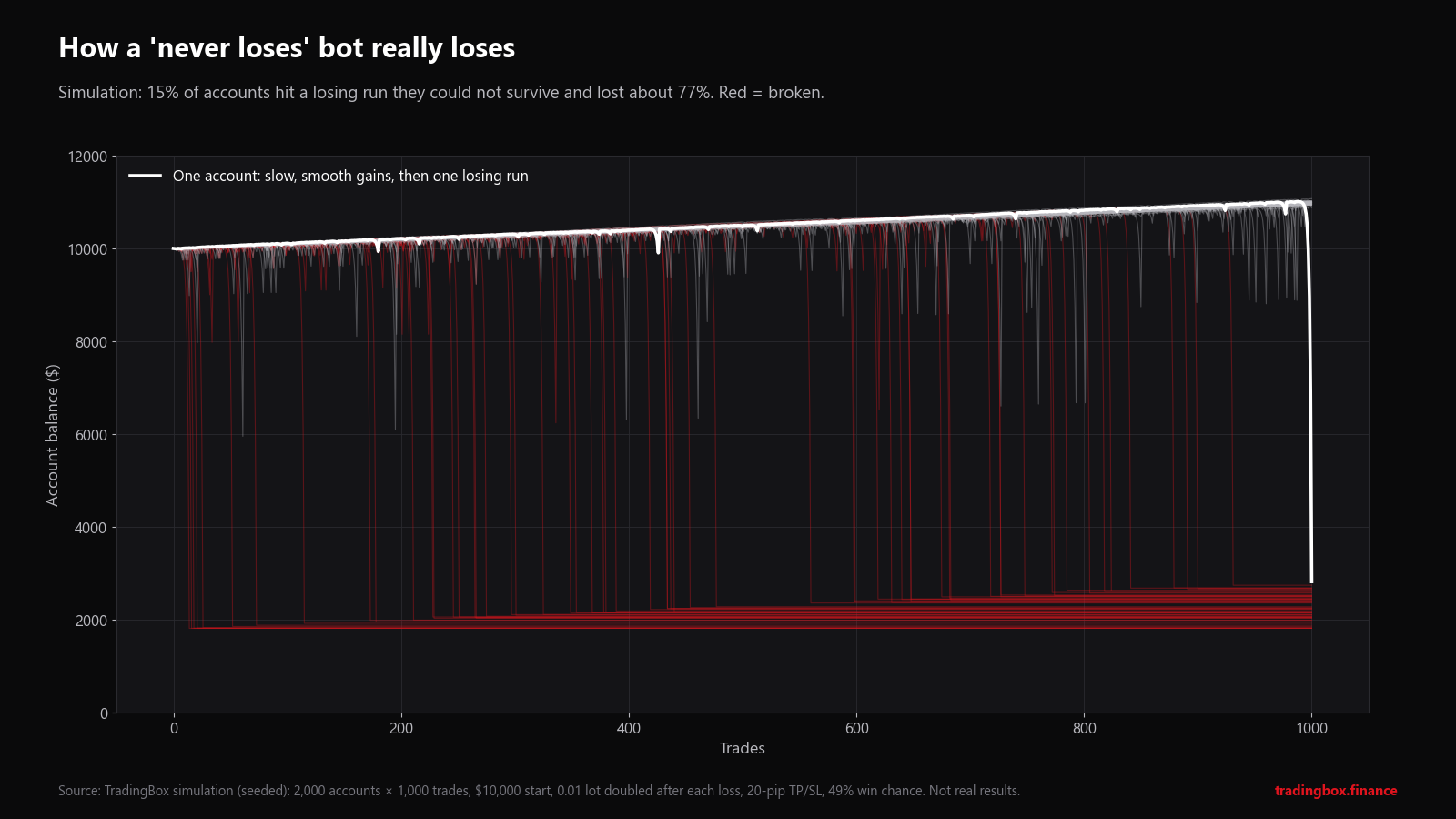
- Most of the time the curve is a smooth line going up. That is the screenshot you see in the advert.
- 15% of the accounts hit a losing run they could not survive within 1,000 trades and lost about 77% of the balance in one go.
- The surviving accounts made a median of about +10% in those 1,000 trades. That is the trade-off: small, steady gains, paid for by a large chance of a catastrophic loss.
Change the settings and the numbers change, but the shape never does. If the advert shows a perfectly smooth equity curve with no losing months, ask how the losses are being hidden.
Red flags checklist
Walk away, or at least ask hard questions, if you see:
- Guaranteed or fixed returns: "10% a month", "no losing trades", "100% win rate".
- No strategy explanation: "proprietary AI" and nothing else.
- Screenshots instead of verifiable records. Screenshots are easy to fake or cherry-pick.
- Backtests you cannot reproduce. You should be able to run the EA in your own Strategy Tester.
- Huge results on a tiny or very new account, or a history that starts right after a big drawdown.
- You must deposit with the seller, or with a broker they choose that you cannot verify.
- Pressure and recruitment: countdowns, "only 5 licences left", commissions for bringing friends.
- No maximum drawdown figure, or one that is suspiciously close to zero.
How to evaluate any EA, AI or not
- Read the rules. You don't need the source code, but the seller should be able to tell you what kind of strategy it is (trend, mean reversion, grid...), how it sets stops and how it sizes trades.
- Run your own backtest in the MT5 Strategy Tester, on your broker's data, with realistic spread. Our backtesting guide shows how, and the traps to avoid.
- Look for the worst drawdown, not the best month. Then ask whether you could sit through it.
- Check for a verified live history of at least several months on a real account, verified by an independent third party, not just a screenshot.
- Run it on a demo account yourself for a few weeks and compare with the backtest.
- Start live with the minimum size and a maximum loss you decide in advance.
Installing an EA to test it takes two minutes: see how to install an Expert Advisor in MT5.
So which should you use?
- If you want to understand and control your trading: a rule-based EA, built from rules you understand and tested properly.
- If you have data skills and patience: a machine-learning model can be a useful component, a filter or a probability estimate, inside an EA with strict risk rules.
- If someone sells you certainty: nothing. No method, AI or otherwise, makes markets predictable.
Frequently asked questions
Do AI trading bots work? Some trading algorithms use machine learning successfully, mostly at large firms with huge data and research budgets, and even they lose money in some periods. A retail product that promises steady high returns because it is "AI" is a warning sign, not a feature.
Is an Expert Advisor the same as a trading bot? Yes, in MetaTrader an Expert Advisor is the official name for a trading bot: a program attached to a chart that can analyse prices and place trades automatically.
Can ChatGPT trade for me? Not by itself. It can help you write or explain code for an EA. The resulting EA still needs testing like any other, and its quality depends on the rules, not on the tool used to write them.
Can an EA learn while it trades? It can be built to retrain or adjust its settings, but self-adjusting systems are very hard to test honestly and can "learn" the wrong lesson from a few unusual weeks. Most professional systems are retrained deliberately, offline, and tested again before use.
How do I know if a robot uses martingale? Watch the lot sizes in its history or in a backtest. If trade sizes grow after losses, or several trades are opened in the same direction as the price moves against them, it is a martingale or grid.
Next steps
- Test strategies by hand before automating them: the MT5 Candle Replay EA replays past charts bar by bar so you can practise entries, exits and lot sizes on history.
- Want an EA built from your own rules, with transparent logic and risk limits? See custom EA development.
- New to MetaTrader? Learn the platform, including installing EAs and the Strategy Tester, in our free MetaTrader 5 Interface course (coming soon: press Notify me).
Sources
- U.S. Commodity Futures Trading Commission: Customer Advisory: AI Won't Turn Trading Bots into Money Machines (25 January 2024).
- CFTC press release 8772-23: federal court orders Mirror Trading International to pay over $1.7 billion (September 2023).
- U.S. Securities and Exchange Commission: press release 2024-36, SEC charges two investment advisers with making false and misleading statements about their use of artificial intelligence (18 March 2024).
- MetaQuotes: ONNX models in MQL5 and the MetaTrader 5 build 3620 release notes (March 2023).
- Martingale figures: TradingBox seeded simulation, settings described above the chart. Not real trading results.
This article is education, not financial advice. Automated trading carries the same high risk of loss as manual trading, plus technical risks.
Trading involves risk. See the risk disclaimer.