
A-Book vs B-Book vs C-Book Brokers Explained
When you press Buy on EURUSD in MetaTrader, someone has to sell it to you. Most traders never ask who. The answer decides how your broker earns money from you, whether your profits are a cost to it, and how it may treat your account if you start winning.
This article explains the three ways brokers handle client orders, known in the industry as the A-book, the B-book and the C-book (or hybrid), with diagrams, worked numbers and the signs to look for in your own broker.
Key takeaways
- A-book: your order is passed to an outside liquidity provider. The broker earns a commission or a spread markup and does not care whether you win or lose.
- B-book: the broker itself takes the other side of your trade. It earns the spread and keeps your losses, but pays your profits from its own money.
- C-book / hybrid: the broker decides per client, and sometimes per trade, how much to pass to the market and how much to keep. Most retail brokers today work this way. "C-book" has no single official definition.
- B-booking is legal and common, but it creates a conflict of interest. Regulation in the EU, UK and Australia exists largely to control it.
- Labels like "STP", "ECN" or "no dealing desk" are marketing terms. The documents that tell you the truth are the broker's order execution policy and conflicts of interest policy.
First, the basics: how a trade is filled
Every trade has two sides. If you buy 1 lot of EURUSD (100,000 euros), someone sells you those 100,000 euros at that moment. For a retail trader, that "someone" is either:
- a bank, prime broker or other liquidity provider (LP) that the broker connects to, or
- the broker itself, trading from its own book.
The broker's choice between those two is its execution model. Brokers call their internal order lists "books", which is where the names A-book and B-book come from.
A-book: the broker as a middleman
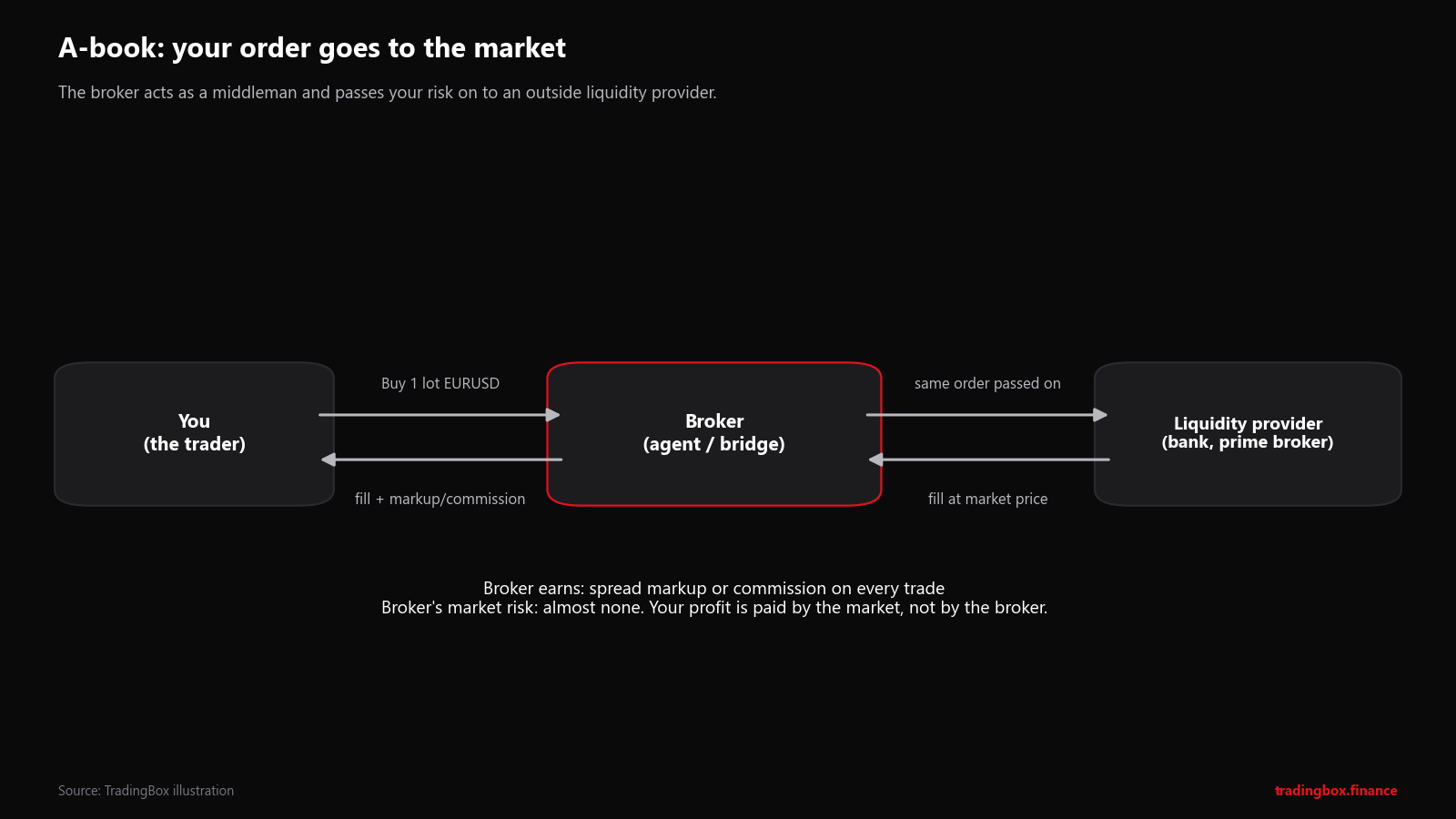
In the A-book model the broker acts as an agent. Your order goes through its system (often called a bridge) to one or more liquidity providers, who fill it at their price. The broker adds its fee and passes the fill back to you.
Also called: STP (straight-through processing), ECN (electronic communication network), agency or NDD (no dealing desk) execution.
How the broker earns money
- a commission per lot (for example $3.50 per side, $7 per round turn on 1 lot), and/or
- a markup on the spread (the LP quotes 0.2 pips, the broker shows you 0.5 pips and keeps 0.3).
Worked example. You buy 1 lot of EURUSD and later sell it 30 pips higher.
- Your profit: 30 pips × $10 per pip = $300, paid by the market through the liquidity provider.
- The broker earns its $7 commission whether you win $300 or lose $300.
Advantages for you: no conflict over your result; the broker is happy if you trade a lot and stay in business for years. Prices usually reflect the real interbank market, with variable spreads.
Disadvantages: commissions, spreads that can widen sharply during news, and minimum trade sizes or costs that make very small accounts less attractive to serve this way.
B-book: the broker takes the other side
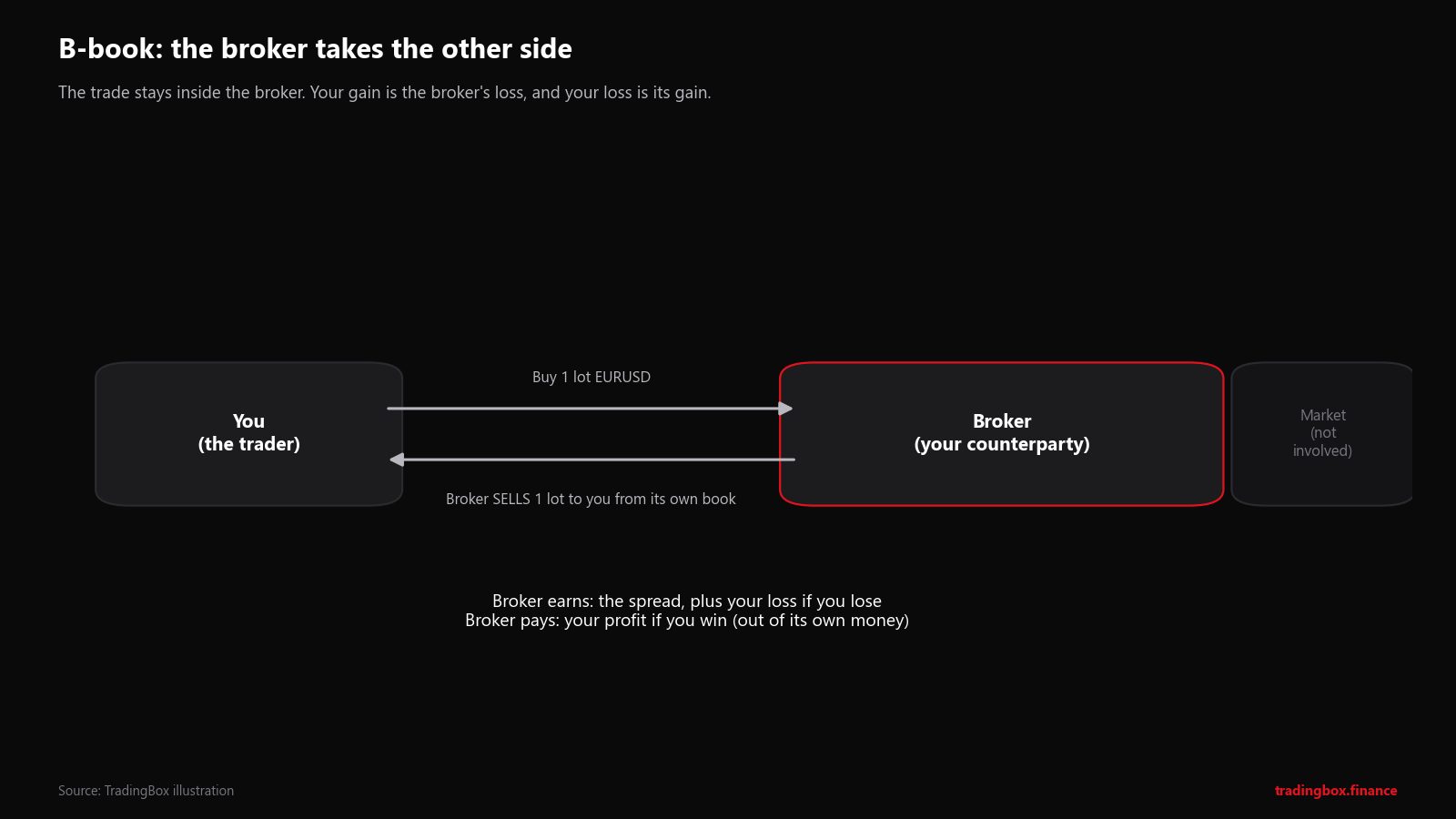
In the B-book model the broker acts as principal: it is your counterparty. When you buy, it sells to you from its own book. Nothing reaches the outside market. This is the classic market maker or dealing desk model.
How the broker earns money
- the spread on every trade, plus
- the net result of its clients: when clients lose, the broker gains the same amount; when clients win, the broker pays them out of its own capital.
Worked example. Same trade: you buy 1 lot of EURUSD.
- If EURUSD falls 20 pips and you close: you lose $200, and that $200 becomes the broker's revenue, on top of the spread.
- If EURUSD rises 30 pips: you win $300, and the broker pays it.
Why would a broker do this?
Because, statistically, most retail clients of leveraged products lose money. This is not an opinion:
- In 2016 the UK Financial Conduct Authority found that 82% of clients in its sample lost money trading CFDs.
- In 2018 the European Securities and Markets Authority (ESMA) reported that national regulators' analyses showed 74–89% of retail CFD accounts typically lose money, with average losses per client between €1,600 and €29,000.
Since then, brokers regulated in the EU and UK must print their own percentage of losing retail accounts in their risk warning. You have probably seen it on broker websites: "XX% of retail investor accounts lose money when trading CFDs with this provider."
If most small clients lose over time, a broker that keeps their trades in-house earns more than one that passes them to the market and collects only a commission.
Same clients, same trades, two different incomes
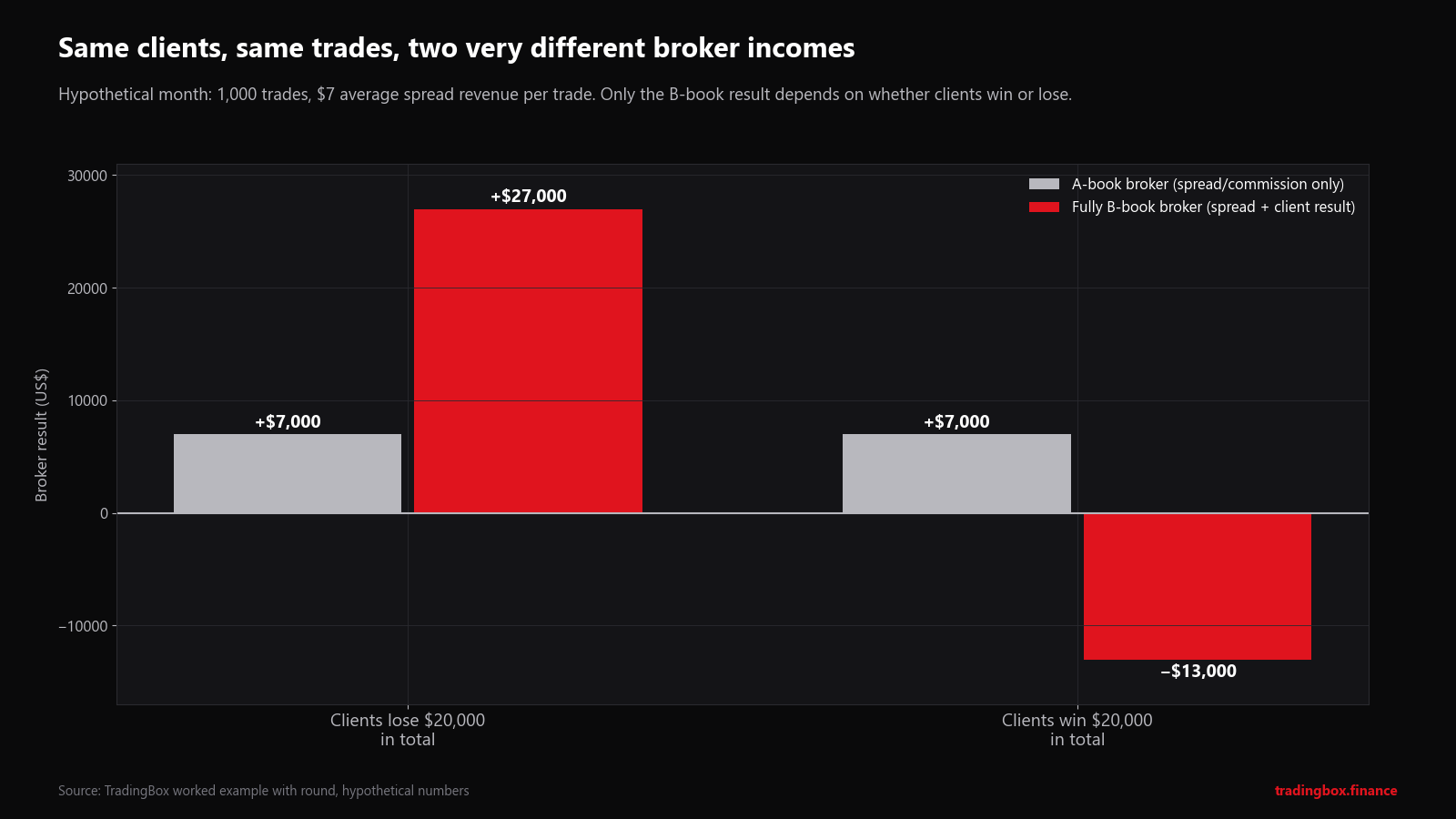
A simple, hypothetical month: 1,000 trades, $7 of spread or commission revenue per trade, clients' net result ±$20,000.
| Clients lose $20,000 | Clients win $20,000 | |
|---|---|---|
| A-book broker | +$7,000 | +$7,000 |
| Fully B-book broker | +$27,000 | -$13,000 |
The A-book broker's income depends only on how much clients trade. The B-book broker's income depends heavily on whether clients lose. That is the conflict of interest.
Advantages for you: fixed or tight spreads, instant fills without slippage in normal conditions, very small trade sizes (micro lots) and low minimum deposits. These are much cheaper for a broker to offer when trades never leave its system.
Disadvantages: the broker's revenue rises when you lose. A well-regulated market maker still has to give you fair prices and execution, but a poorly regulated one has both the motive and the means to make your life harder.
Netting: not the same as B-booking
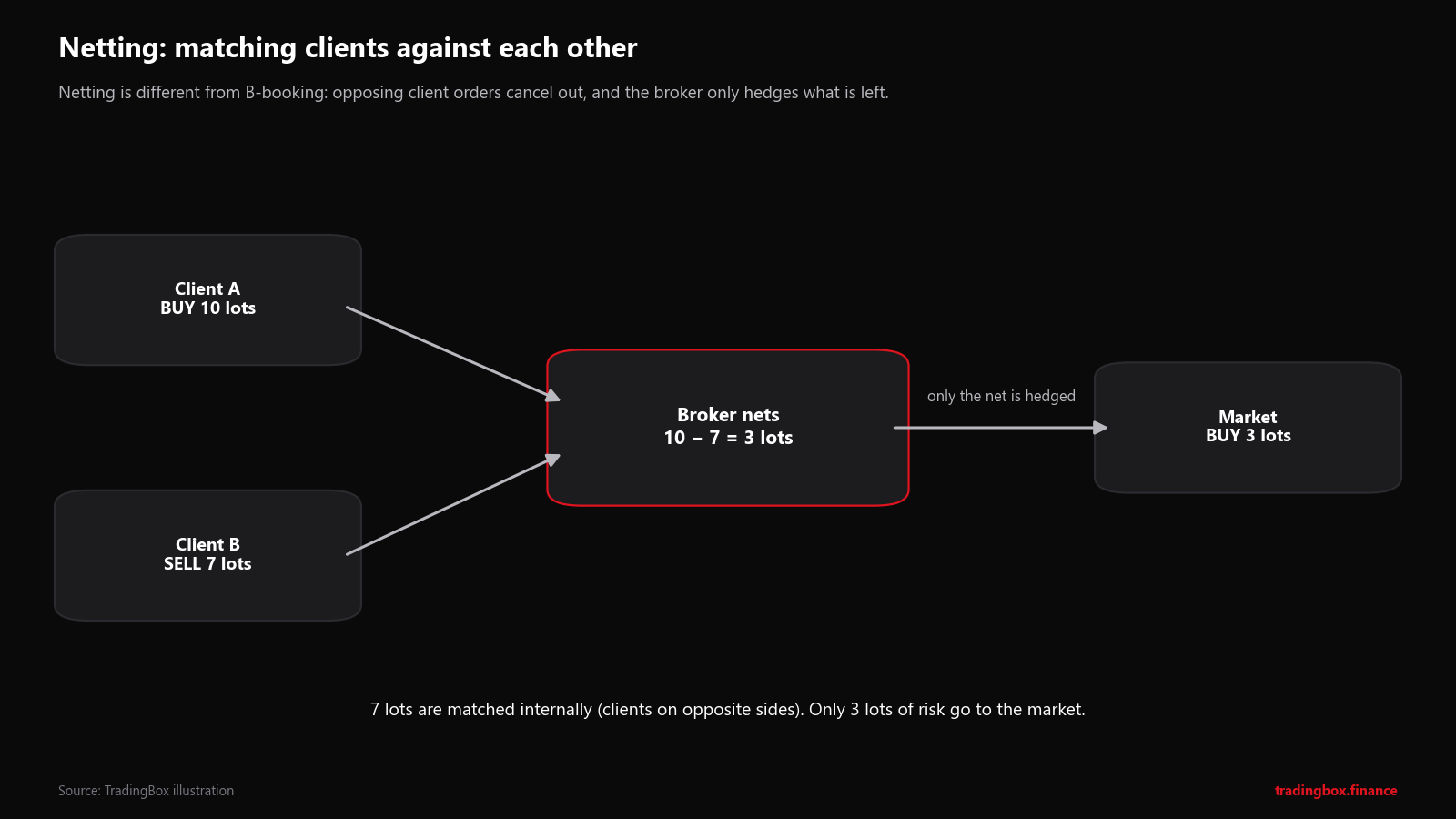
Brokers have thousands of clients trading in both directions. If client A buys 10 lots of EURUSD and client B sells 7 lots, the broker can match 7 lots between them and only send the remaining 3 lots to the market. This is called netting or internalisation.
Netting reduces costs and does not by itself mean the broker is betting against you: the matched clients are each other's counterparties. The broker still carries the risk of the unmatched part, unless it hedges it.
C-book: the hybrid model most brokers use
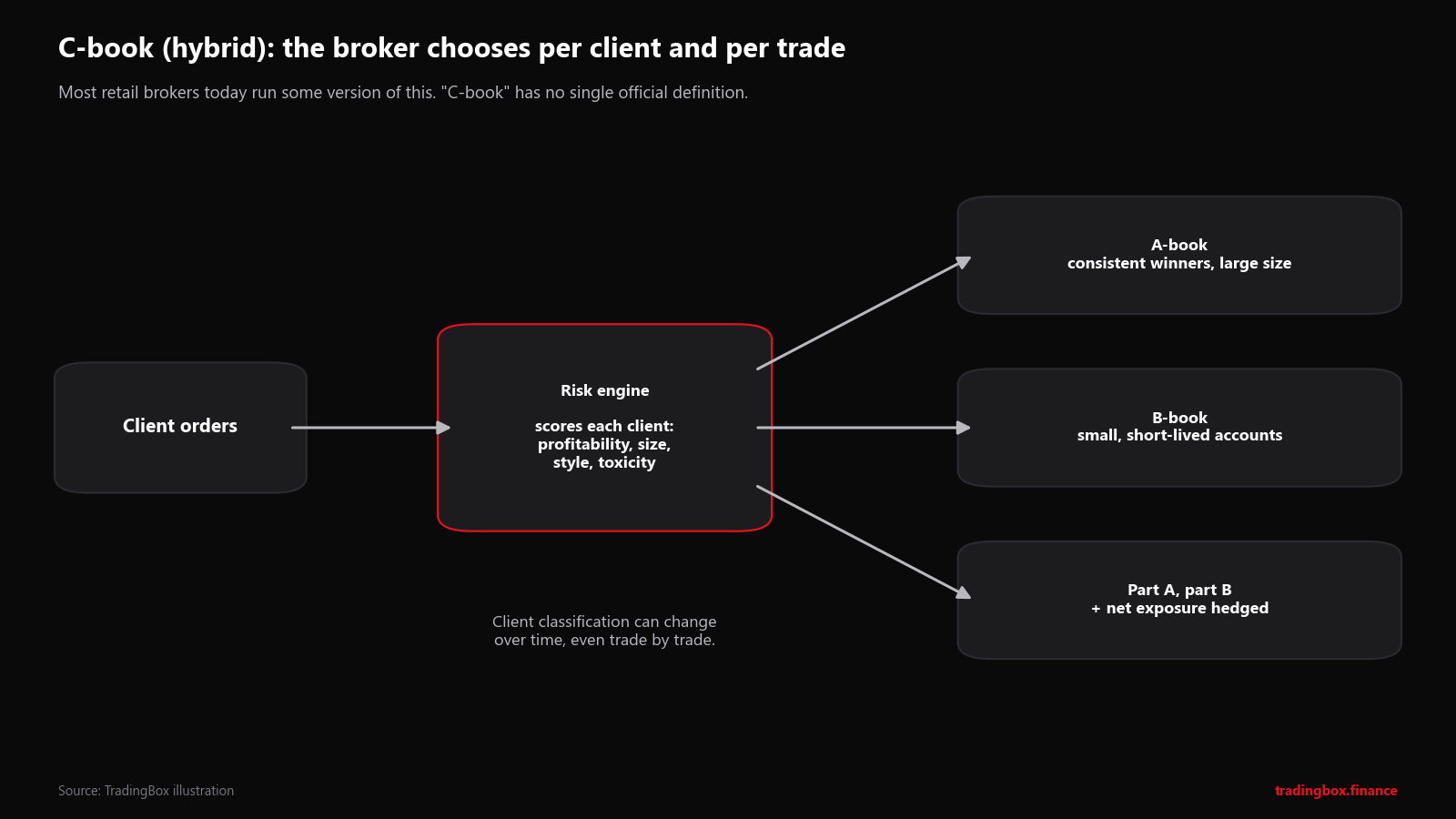
Almost no large retail broker today is purely A-book or purely B-book. Instead, a risk management system scores each account (and sometimes each order) and decides where it goes:
- Clients who consistently win, trade large sizes or trade in a way that is hard to profit from (for example fast news trading or arbitrage) are usually sent to the A-book, so the broker is not exposed to them.
- Small, short-lived accounts, which statistically lose, are usually kept on the B-book.
- Everything in between may be partly kept and partly passed on, with the broker hedging its overall net exposure rather than each trade.
The industry uses the word C-book for two related ideas, and you will see both online:
- the hybrid model itself (choosing A or B per client or per trade), or
- partial or dynamic hedging, where the broker keeps a percentage of a flow and passes the rest, adjusting as the client's history grows.
Either way, the key point is the same: your treatment can change over time. A new account may start on the B-book and be moved to the A-book after a run of profitable months, or the other way around.
Is B-booking bad?
Not automatically. A regulated market maker is a legitimate business model, used for decades. What matters is how it is regulated and supervised.
In the European Union, the rules come mainly from MiFID II (Directive 2014/65/EU) and ESMA's product measures:
- Conflicts of interest must be identified, managed and disclosed (Article 23 of MiFID II).
- Best execution: the firm must take sufficient steps to obtain the best possible result for the client and publish an order execution policy (Article 27).
- Since 2018, retail CFD clients get leverage limits (for example 30:1 on major currency pairs, 20:1 on gold and major indices), negative balance protection, a margin close-out rule at 50% of required margin, and a ban on bonuses used to attract clients.
The UK (FCA) and Australia (ASIC) apply similar protections. The real danger lies with offshore or unregulated brokers, where nobody checks how prices are made or how complaints are handled.
Signs that tell you how your broker treats your trades
None of these is proof on its own. Many have innocent explanations. But several together tell you a lot.
In the documents (the most reliable source):
- The order execution policy says the firm "acts as principal" or "is the counterparty to your trades". That is a direct statement of B-book or hybrid execution. An agency (A-book) broker will say it acts as agent and name or describe its liquidity providers.
- The conflicts of interest policy mentions "hedging", "risk management" or "internalisation" of client positions.
- The legal entity you signed with: is it the regulated EU, UK or Australian company, or an offshore subsidiary of the same brand? The same logo can hide very different protection.
In your trading experience:
- Asymmetric slippage: you often get worse prices than you clicked, but almost never better ones. A fair execution system produces slippage in both directions.
- Requotes or rejections mostly when the market moves in your favour.
- Fixed spreads that never change, even during major news, may indicate prices are made internally.
- Prices or spikes that do not appear at other brokers at the same time, especially ones that touch stop losses.
- New restrictions after profitable months: wider spreads, delays, changed account terms or limits on "scalping" and "news trading".
- Bonuses with withdrawal conditions (banned for retail CFD clients in the EU and UK).
What you can do:
- Read the order execution policy and the conflicts of interest policy before you deposit.
- Check the licence number on the regulator's own public register (FCA, CySEC, ASIC and others), not just on the broker's website.
- Ask support in writing: "Who is the counterparty to my trades on this account?" A good broker answers clearly.
- Keep your own records. Export your trade history from MT5 and compare requested prices with filled prices over a few hundred trades.
What it means for your trading
- If you are a beginner with a small account, you are very likely on a B-book. That is not a reason to panic. It is a reason to choose a broker with strong regulation and to avoid brokers you cannot verify.
- If you trade news or scalp very short moves, execution quality is part of your edge. Choose a broker whose documents describe agency execution and test it with small size first. Our economic calendar guide shows what typically happens to spreads and fills around a release.
- If you become consistently profitable, expect your broker's treatment of your account to change. With a good broker, you simply move to A-book flow. With a bad one, you may meet the warning signs above.
- Whatever the model, the trading costs you can see (spread, commission, swap) and the ones you cannot (slippage) both reduce results. Measure them.
Frequently asked questions
Is an ECN account always A-book? No. "ECN" and "STP" are marketing labels, not legal categories. The order execution policy tells you how the firm actually acts.
Can a broker move my account between A-book and B-book? Yes. In the hybrid model this is normal and can happen at any time without notice to you.
Does B-book mean the broker will manipulate prices? A regulated broker must give fair prices and best execution and is supervised for it. The conflict of interest exists, but regulation is designed to control it. The risk of abuse is much higher with unregulated or offshore entities.
Do I make more money with an A-book broker? Not necessarily. The execution model does not change whether your strategy works. It changes how your broker earns money and how it may respond if you win.
Sources
- European Securities and Markets Authority (ESMA), ESMA agrees to prohibit binary options and restrict CFDs to protect retail investors, press release, 27 March 2018.
- UK Financial Conduct Authority, CP16/40: Enhancing conduct of business rules for firms providing contract for difference products to retail clients, December 2016.
- Directive 2014/65/EU (MiFID II), Article 23 (conflicts of interest) and Article 27 (best execution).
- Diagrams and the worked example are TradingBox illustrations with hypothetical numbers.
This article is for education only and describes industry practice in general terms. It does not describe or assess any specific broker. Trading leveraged products such as CFDs carries a high risk of losing money.
Trading involves risk. See the risk disclaimer.